
18.Glaciers under threat
Students investigate Icelandic glaciers and climate change using VR simulations, data analysis and ethical debate. The unit links glacier retreat, emissions, sea-level rise and climate justice, leading to evidence-based climate action proposals.

19.Science & Technology for Sustainability – Geothermal Sensors
Students explore Iceland’s geothermal energy systems and the role of sensors, robotics and data dashboards in safe renewable energy production. VR missions support scientific data interpretation, emergency response and engineering design.

28.From Coal to Renewables – Poland’s Energy Future
Students explore Poland’s transition from coal to renewable energy through VR, data analysis and city energy modelling. The unit develops understanding of energy sources, climate impacts, passive-house design and sustainable urban energy planning.
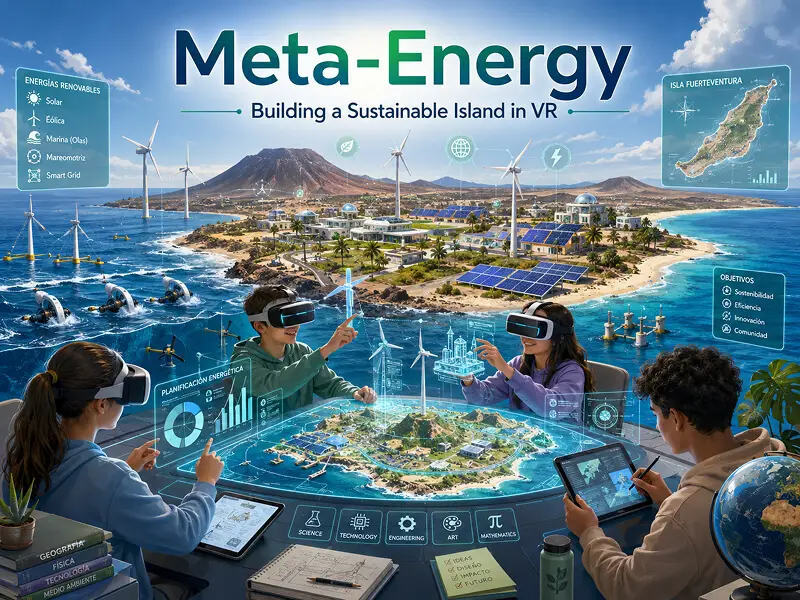
Meta-Energy: Building a sustainable island in RV
Students design and communicate renewable-energy solutions for Fuerteventura using research, expert input, VR simulations and AR markers. The unit links physics, technology, geography, economics, sustainability and gender awareness in energy engineering.

12.Surviving the snow: safe mobility in Iceland
Students study how snow, ice, darkness and winter storms affect mobility and road safety in Iceland. Through VR winter scenarios and data analysis, they connect friction, speed and stopping distance to sustainable safety solutions.
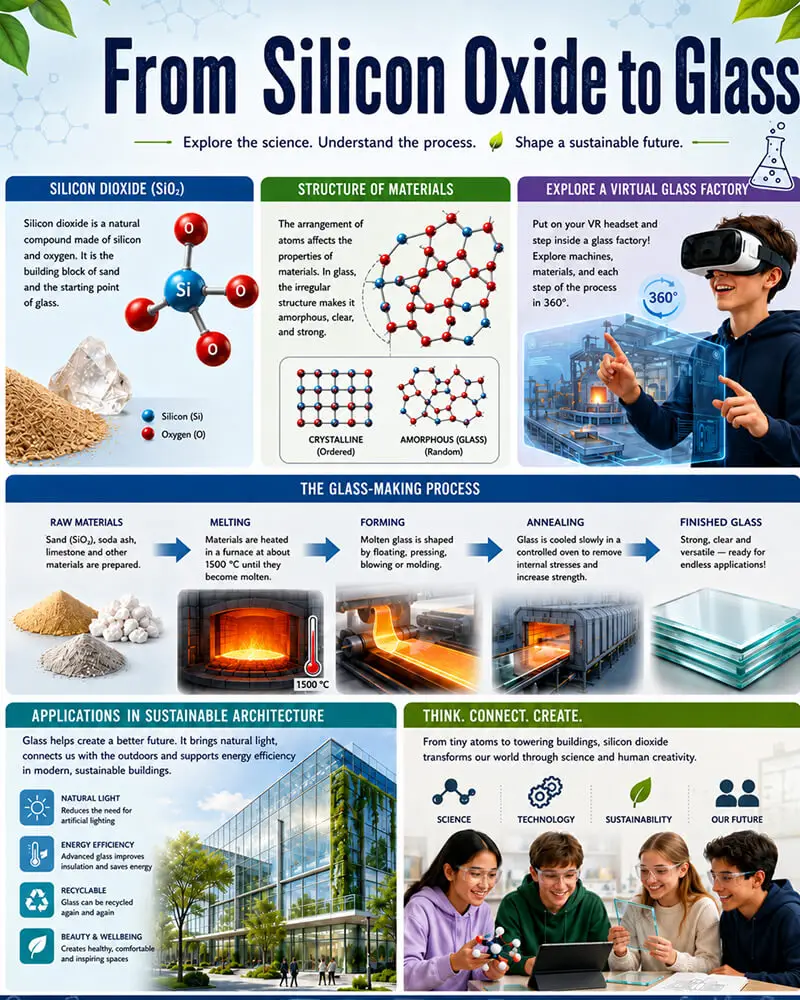
21.From silicon oxide to glass.
Students learn how silicon dioxide is transformed into glass and how glass properties depend on chemical composition. The lesson connects chemistry, physics, technology and sustainable architecture through VR factory and city applications.
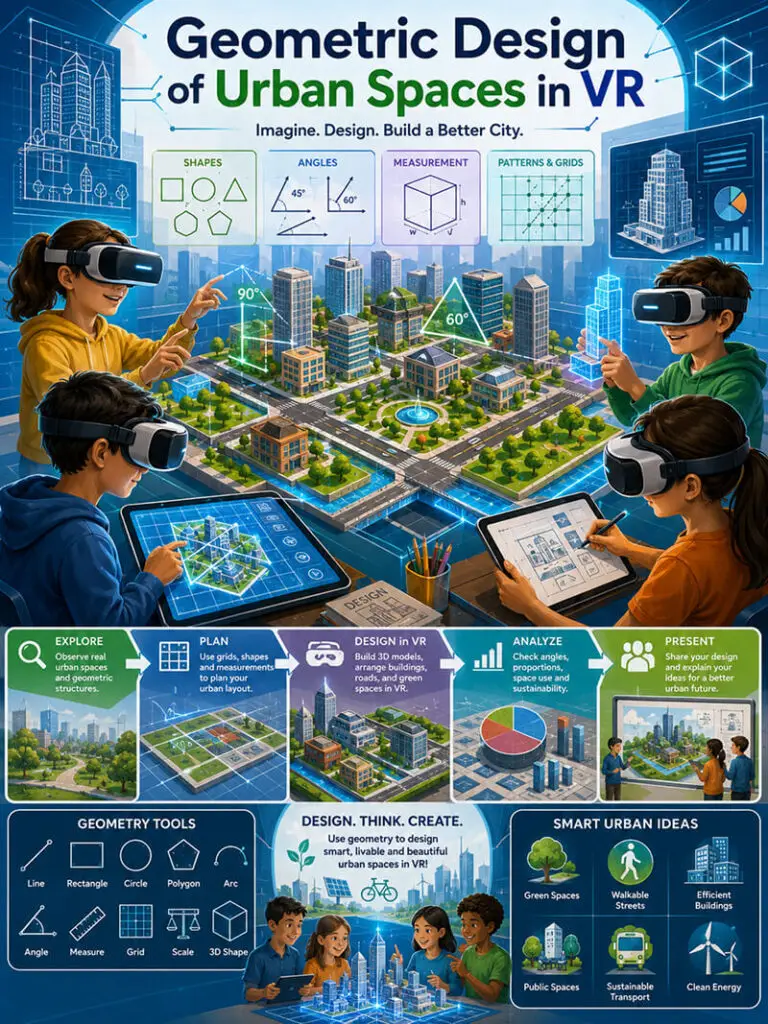
31.Geometric Design of Urban Spaces in VR
Students apply geometry, scale, symmetry and spatial reasoning to urban design in VR. Working in teams, they create a 3D/VR model of a future city fragment and justify functional, aesthetic and sustainability choices.

34.Neighbourhood sustainability: We analyze the city Is our neighbourhood sustainable? (Situation 1)
Students work as an urban consulting team to analyse neighbourhood sustainability using quantitative data. They collect spatial information in VR, calculate statistical measures, create graphs and prepare a mathematical sustainability diagnosis.

36.Neighbourhood sustainability: Optimization and sustainability What is the best possible design? (Situation 2)
Students present a sustainable neighbourhood proposal as if addressing a city council or public audience. They use VR, graphs and mathematical arguments to explain decisions, answer questions and evaluate peers’ proposals.

37. Neighbourhood sustainability: We present our sustainable neighborhood (Situation 3)
Students present a sustainable neighbourhood proposal as if addressing a city council or public audience. They use VR, graphs and mathematical arguments to explain decisions, answer questions and evaluate peers’ proposals.